
FIFA FOCUS: A Step Forward for On-Pitch Concussion Assessment
by David Bartlett, Men’s Team Physiotherapist at Welsh Fire and Concussion Clinic at Institute of Sport & Exercise Health (ISEH).
A structured, consistent, football-specific on-pitch protocol does two things at once. It gives clinicians a defined path to follow under pressure, and it finally makes on-pitch assessment data worth collecting.
Anyone who has run onto a pitch to assess a head injury knows the environment before they reach the player.
The crowd is loud. Coaching staff are asking whether the player can continue. Officials are watching the clock. Team-mates are hovering. The player, in almost every case, is already telling you they feel fine, because they want to keep playing.
The decision rule itself has never been the difficult part. If in doubt, sit them out. That principle is settled, it is not negotiable, and removing a player is never the risky option. Any clinician working pitch-side applies it without hesitation.
The difficulty has always been the evidence you can gather in the time available to inform that judgement. Until now, the on-pitch toolkit has been short: visible signs, reported symptoms, and Maddocks questions. All useful, but all weighted heavily towards what the athlete is willing and able to tell you, at the precise moment they are least equipped to tell you anything reliable.
That is a narrow base on which to build a consistent, repeatable, defensible assessment. FIFA FOCUS widens it considerably.
Structure first, because structure is what the environment destroys
The Football-Specific Standardised On-Pitch Concussion Assessment Protocol, published by FIFA in April 2026, was developed from a comprehensive review of the scientific evidence in collaboration with a global group of clinicians and researchers with expertise in concussion identification and assessment in football.
Its single greatest contribution is that it imposes order on a situation designed to prevent it.
FOCUS sets out eleven assessment domains, each with defined guidance and, critically, a defined action attached to each finding:
- Player medical history. Previous concussion, a previous head impact or head injury assessment within the same match, and anticoagulation therapy.
- Mechanism of injury. Was this a concerning mechanism? Head-to-head, elbow-to-head, head-to-ground (particularly from a height or an unprotected fall), foot-to-head, or dual impacts.
- Observation. Visible signs, observed from the touchline onwards and throughout, not only once you arrive.
- Level of consciousness. Assessed formally on ACVPU, working from best to worst.
- Cervical spine. Pain at rest, midline tenderness, active range, strength and sensation.
- Symptoms. Ten defined items, from headache and dizziness through visual disturbance to acute hearing loss.
- Orientation. The five Maddocks questions, with guidance on what constitutes an appropriate response.
- Balance. Tandem stand, eyes closed, twenty seconds.
- Proprioception. Finger to nose, eyes closed, left hand then right.
- Oculomotor. Smooth pursuit and convergence, with checks for nystagmus and pupil abnormalities.
- Activity-based assessment. On the touchline, and only when every other item is normal: 5m sprint, 180-degree turn left, 5m, 180-degree turn right, 5m, looking for anything exertion provokes.
Every item resolves to one of two actions. Substitute immediately and complete the assessment off the pitch, or lower the threshold of concern and continue assessing.
That second category is the most clinically sophisticated part of the protocol. Previous concussion, a prior head impact in the same match, anticoagulation, a concerning mechanism, neck pain at rest, a blank or vacant look, a superficial head injury. None of these require removal on their own, but each one moves the bar for everything that follows. It formalises the weighting that experienced clinicians already apply instinctively, and it makes that weighting explicit, teachable and consistent across a medical team.
The result is that the same player, assessed by two clinicians at two clubs on two weekends, receives the same assessment in the same order against the same criteria. In an environment with noise, time pressure and competing interests, a defined path to follow is worth a great deal. It supports the clinician making the decision, it makes the process visible to everyone else, and it produces a record that stands up afterwards.
And all of it takes three minutes with no equipment needed.
It is multimodal, so it does not rely on the athlete
The second advance is that FOCUS adds performance-based testing to what was previously an assessment dominated by self-reporting.
Balance, proprioception and oculomotor function are objective. A player cannot report their way past a failed convergence test, an loss of balance on tandem stance, or an inability to complete finger to nose with eyes closed. Nystagmus and pupil abnormalities are observed, not asked about. The activity-based assessment then loads the system before the player returns, rather than assuming a static assessment predicts what change of direction will do.
For the presentations where a mechanism is concerning but the athlete reports well, that shift from asking to testing is significant.
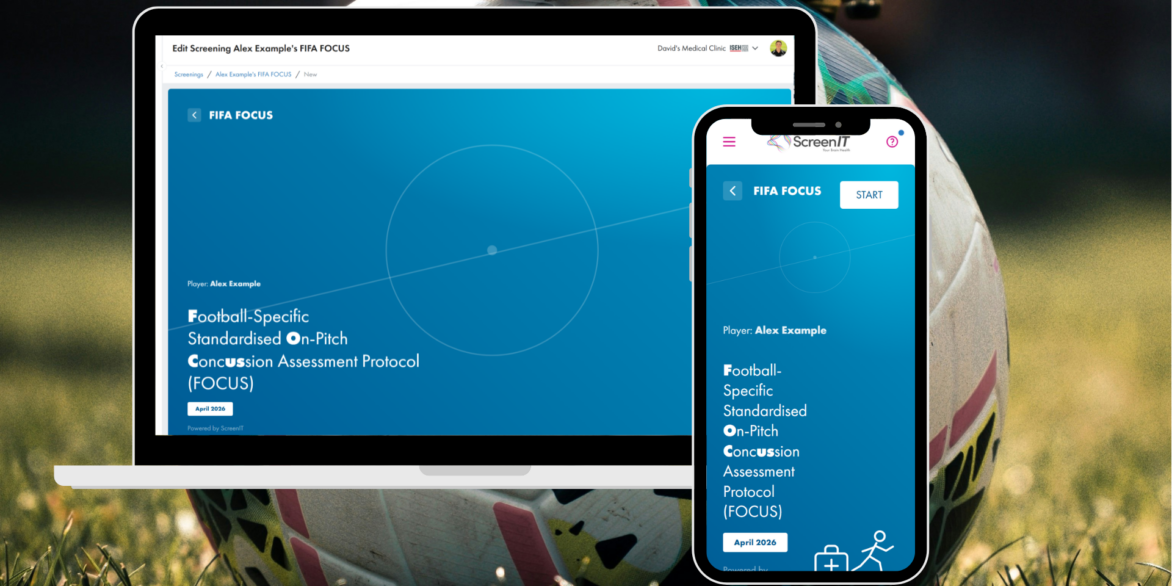
Digital FIFA FOCUS on ScreenIT
A real example from cricket
The video below is from The Hundred this summer, where I was the run-on physio for Welsh Fire. Sam Cook goes for a ball in the field and lands awkwardly.
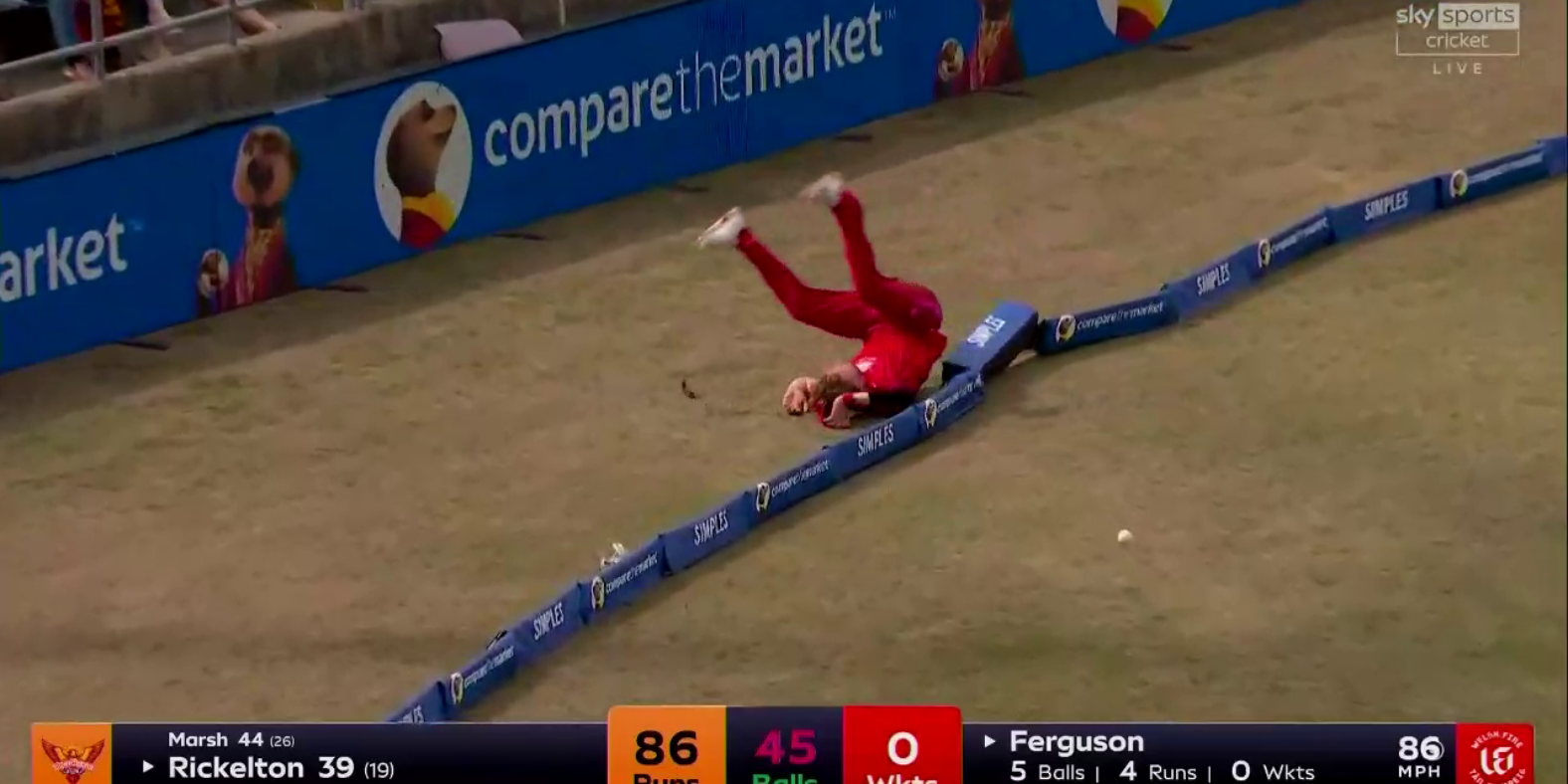
Sam Cook goes for a ball in the field and lands awkwardly.
What I could see in real time was a rapid head movement on landing – a mechanism entirely capable of producing a concussion.
He was assessed on that basis. The full assessment was completed, he was monitored, and fortunately he did not sustain a concussion.
The example is not about the outcome, which was clear. But still, I had a concerning mechanism in front of me and an assessment toolkit built largely around signs, symptoms and orientation. But those tools were never designed to interrogate a mechanism-driven presentation in an athlete who presents well, and there is no reason on-pitch assessment should stay that narrow.
FOCUS is what closes that. Same three minutes, considerably more to work with.
The research case is just as strong as the clinical one
This is the part I think is underappreciated.
On-pitch assessment has historically been close to unusable as data. It happens quickly, it varies by clinician and by sport, and it is typically recorded afterwards as free text if it is recorded at all. There has been no standardised, itemised, comparable record of what was actually observed and tested at the pitchside.
A standardised protocol changes that in one step. FOCUS produces a defined set of items with defined responses, captured at the moment of injury. Collected consistently, that becomes a genuine dataset.
Married to what comes next, it becomes a powerful one. Link the on-pitch record to the subsequent SCAT6, then to SCOAT6 in the days that follow, then to the eventual diagnosis and return-to-play timeline, and a set of questions that have been difficult to answer become tractable:
- Which on-pitch items carry real predictive weight for a subsequent confirmed concussion, and which are contributing less than we assume?
- Do specific mechanisms map to specific deficit profiles, and can we anticipate them?
- What are the sensitivity and specificity of individual domains, particularly the performance-based ones, in a live match environment rather than a laboratory?
- How do the mechanism-driven presentations, the ones with no visible sign and no reported symptom, actually resolve?
That is a research agenda that has not previously been open to us, because the input data did not exist in comparable form. Standardisation at the point of injury is the prerequisite for everything downstream. It also means every assessment carried out under the protocol contributes to improving the protocol, which is how a tool gets better over time rather than staying static.
What FOCUS is not
It is worth being precise. FOCUS is not a diagnostic tool and it does not replace a thorough off-pitch clinical assessment. It is designed to identify the players who needs to be removed from play for a formal assessment, and it is explicit about that scope.
That clarity is a strength. It sits cleanly alongside SCAT6 & SCOAT6 rather than competing with any of them, and it does not ask the on-pitch window to carry more than it can.
Why this reaches beyond football
Football, rugby, boxing and cricket – the constraints are identical in every one of them. Limited time, high noise, competitive pressure, and an athlete with every incentive to under-report.
FOCUS was written for football and it should be applied as written in football. But the principle it establishes travels. The on-pitch window can support far more than signs, symptoms and orientation, and a structured multimodal protocol makes better use of three minutes than any of us can manage from memory alone. Every sport managing head impact should be asking what its own version looks like.
The point
For years, the honest position on on-pitch concussion assessment has been that clinicians were applying a sound decision rule using a narrow evidence base, in the least forgiving environment in sports medicine.
FOCUS widens that evidence base and gives it a defined structure. It supports better decisions in the moment, it makes those decisions consistent and defensible across clinicians and clubs, and for the first time it turns the pitchside into a place where we can learn something.
Where to find it
FIFA has published FOCUS openly through its medical resources.
We have also built it into ScreenIT, where it sits free alongside CRT6, SCAT6, SCOAT6 and SMHAT-1. Same protocol, same decision logic, structured on screen so the assessment is prompted and recorded as you work through it, with the result stored against the athlete’s profile rather than written up from memory afterwards. That matters for the clinical record, and it is what makes the research use above practical rather than theoretical.
Use FIFA FOCUS for free today at: www.screenit.health
Digital FIFA FOCUS on ScreenIT